When the suffering of another human being becomes a spectacle, what does it do to our souls?
There is a difference between justice and spectacle. And I fear that we are becoming increasingly comfortable confusing the two.
The recent news surrounding plans to livestream the execution of a convicted murderer has brought that distinction into focus for me. I have no desire to minimize the horrific crimes committed or the suffering of the victims and their families. There is real evil in this world, and justice matters. The lives taken matter. The grief carried by those left behind matters.
But I find myself troubled by something beyond the question of whether the death penalty is justified.
Why do we need to watch?
What is accomplished by turning the death of another human being into something for public consumption? And perhaps more importantly, what happens to us when we do?
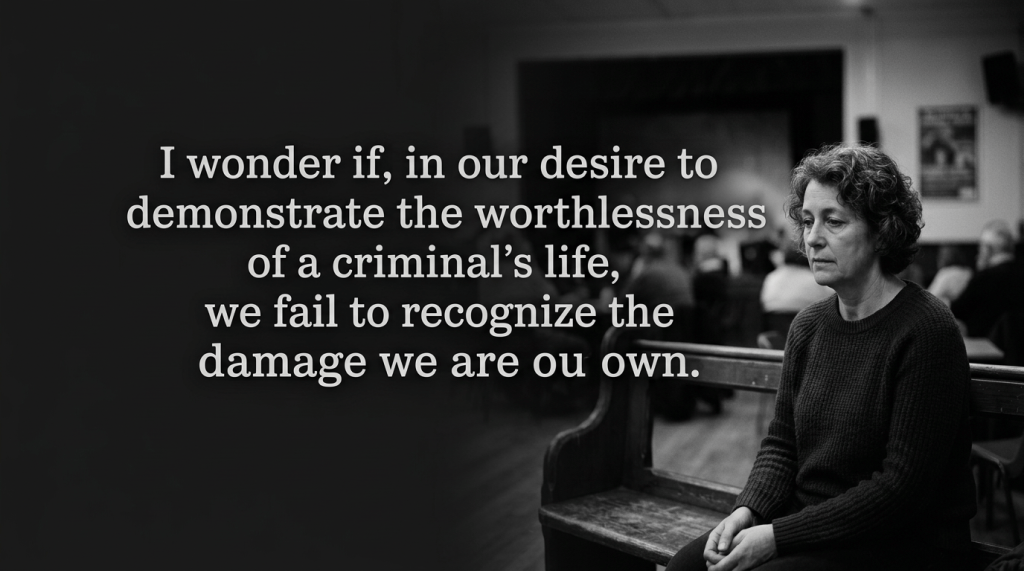
I wonder if, in our desire to demonstrate the worthlessness of a criminal’s life, we fail to recognize the damage we are doing to our own.
The Image We Cannot Erase
The opening chapters of Genesis tell us that humanity was created in the image of God. It is one of the most foundational claims of Christian theology, and one whose implications we often fail to take seriously.
To be human is to bear the image of our Creator.
Not because we are good. Not because we are innocent. Not because we have earned the right to be treated with dignity.
We bear God’s image because God made us in his image.
That distinction matters.
It means that human dignity is not something we bestow upon one another, nor is it something we have the authority to revoke. Even the person guilty of the most horrific acts remains human. Sin can profoundly distort the image of God in us, but it cannot undo the reality that we were created in that image.
James makes this connection when he confronts the contradiction of using our tongues to praise God while cursing other human beings.
“With it we bless the Lord and Father, and with it we curse those who are made in the likeness of God.” (James 3:9)
James is concerned with more than our language. He is exposing a fundamental contradiction in our worship. How can we claim to honor God while dishonoring those who bear his likeness?
We cannot separate our treatment of human beings from our relationship with the God who created them.
And this raises an uncomfortable question.
When we reduce another human being to nothing more than the worst thing they have ever done, what happens to our own ability to recognize the image of God?
The Spectators
In his Confessions, Augustine tells the story of his friend Alypius, who was persuaded to attend the gladiatorial games in Rome.
Alypius wanted nothing to do with the violence. He entered the arena determined not to participate, closing his eyes so that he would not witness the brutality unfolding before him.
But then the crowd roared.
Curiosity got the better of him. He opened his eyes, saw the bloodshed, and something changed.
Augustine describes how Alypius, who had entered the arena opposed to the spectacle, became captivated by it. He began cheering alongside the crowd. The man who had refused to watch became a willing participant.
I find this story deeply unsettling.
Not simply because of the violence in the arena, but because of what happened in the stands.
The gladiators were not the only ones being changed by the violence. The spectators were being formed by it as well.
Augustine understood something about human nature that we would do well to remember. We are shaped by the things we give ourselves to. What we watch, what we celebrate, what we learn to enjoy…these things do not leave us unchanged.
We often imagine ourselves as detached observers, capable of witnessing cruelty without being affected by it.
But what if we are not?
What if every time we learn to take pleasure in another person’s suffering, something within us becomes a little less capable of compassion?
What if the real danger is not simply that we stop seeing the humanity of the person suffering, but that we begin losing something of our own humanity in the process?
When Justice Becomes Entertainment
Scripture does not suggest that evil should go unpunished. Justice recurs throughout both the Old and New Testaments.
But Scripture also does not invite us to delight in the destruction of those who have done wrong.
“Do not rejoice when your enemies fall, and do not let your heart be glad when they stumble.” (Proverbs 24:17)
And through the prophet Ezekiel, God declares:
“I have no pleasure in the death of the wicked, but that the wicked turn from their ways and live.” (Ezekiel 33:11)
There is something important here.
We can recognize the necessity of justice without celebrating suffering. We can acknowledge the severity of a crime without stripping the criminal of their humanity. We can grieve with victims without allowing our grief to become an excuse for cruelty.
These are not contradictions.
They are the difficult demands of a faith that insists every human being bears the image of God.
And yet, we seem increasingly drawn to public displays of humiliation and punishment. We share videos of people being beaten. We celebrate the suffering of those we regard as enemies. We turn the downfall of others into entertainment, often justifying our enjoyment by reminding ourselves that they deserved it.
Perhaps they did deserve consequences.
But deserving consequences and deserving to be dehumanized are not the same thing.
And the question remains: What is happening to us as we watch?
The Spectacle of the Cross
There is an irony here that Christians, of all people, should recognize.
At the center of our faith stands a public execution.
Crucifixion was not merely a means of putting someone to death. It was a spectacle, designed to humiliate the condemned and demonstrate the power of Rome.
The victim was stripped, exposed, mocked, and displayed before the public. The message was unmistakable. This is what happens to those who stand against the powers that be.
And it was into that spectacle that Jesus was led.
Luke tells us that the people stood watching while the leaders scoffed at him. Soldiers mocked him. Others challenged him to save himself.
The crowd saw a condemned criminal.
But Christians confess that the one hanging on the cross was the fullest revelation of God.
I wonder how often we consider the implications of that.
The cross reveals not only the suffering love of God, but also the terrible capacity of human beings to participate in cruelty while believing themselves justified.
We know that Jesus was innocent. That is an important distinction. But if the only lesson we take from the crucifixion is that we should not execute innocent people, I think we have missed something essential.
The cross also confronts the way we look upon the suffering of others.
It challenges our willingness to let the powerful define whose humanity matters. It exposes our capacity to join the crowd. And it reveals a God who, even in the midst of his own execution, prays for those responsible.
“Father, forgive them; for they do not know what they are doing.” (Luke 23:34)
That is a radically different response to evil than the one we are so often tempted to embrace.
What We Are Becoming
I am not suggesting that we abandon justice. Nor am I suggesting that we ignore the suffering of victims or diminish the seriousness of horrific crimes.
But I am suggesting that the way we pursue justice matters.
The way we speak about those who have done wrong matters.
And the things we choose to celebrate matter.
Because the Christian life is not simply about avoiding certain actions or holding the correct beliefs. It is about being transformed into the likeness of Christ.
It is about becoming people whose lives increasingly reflect the love, mercy, holiness, and justice of God.
And that transformation is not disconnected from the way we treat other human beings, including those we find most difficult to love.
I fear that when we turn another person’s death into a spectacle, we are doing more than making a statement about the value of their life.
We are making a statement about the kind of people we are willing to become.
We are teaching ourselves, and perhaps our children, that there are circumstances in which another human being’s suffering is something to be enjoyed. That there are people whose humanity no longer deserves our recognition. That cruelty becomes acceptable when directed toward someone we believe deserves it.
And once we have learned that lesson, I wonder how easily we can unlearn it.
The danger of dehumanization is not simply what it allows us to do to others. It is what it does to us.
When we cease to recognize the image of God in another person, we do not actually erase that image from them. We damage our own ability to see it.
And in doing so, we diminish our capacity to reflect that same image ourselves.
Perhaps that is why Jesus calls us to love our enemies. Not because evil does not matter. Not because justice is unnecessary. But because refusing to love our enemies ultimately changes us into people who look less and less like the God we claim to worship.
The question is not simply whether justice has been done.
It is whether, in the process, we are becoming more like Christ.
And I cannot help but wonder whether a society gathered around the spectacle of another human being’s death is moving in that direction at all.
Subscribe
Make sure to subscribe to the blog or follow me on Facebook (both options available at the bottom of the page). Please share with your friends or church if you find these posts helpful or thought-provoking.
Support
If you find any of this helpful and want to support these projects, you can click the Support button below to “Buy Me A Coffee”


Leave a Reply