The Desperation of Smaug
In the first post of this series, we looked at the damnation of Smaug, how hoarded wealth corrodes the soul. Smaug sits enthroned on treasure he did not create, guarding riches he does not use, his identity wrapped entirely around possession.
But the story of Smaug in The Hobbit does not end with a dragon quietly sleeping on gold.
Eventually, something changes.
A single cup goes missing.
It is a small thing in the middle of an unimaginable hoard, but to Smaug it is catastrophic. He begins counting his treasure. Suspicion rises. Rage follows.
And then the dragon does something revealing.
He does not search carefully for the thief.
He does not pause to understand what has happened.
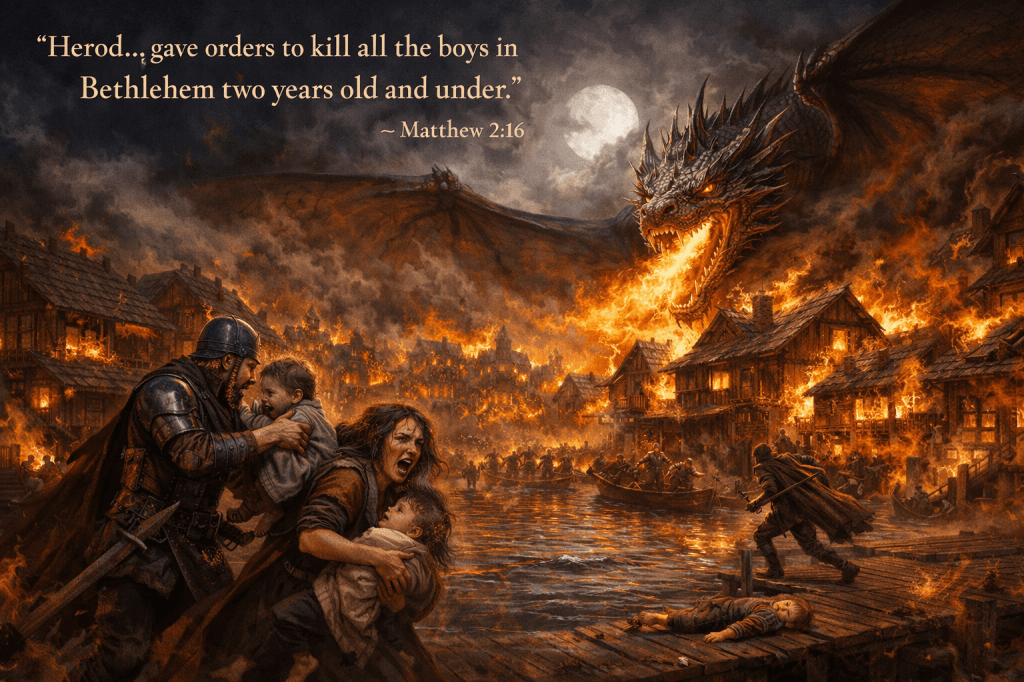
He flies into a fury and burns Lake-town, unleashing destruction on people who had nothing to do with the missing cup.
Smaug’s reaction reveals something important.
When wealth becomes identity, loss feels like death.
When power depends on possession, even small threats provoke a violent response.
What begins as hoarding eventually becomes desperation.
When Power Feels Threatened
The Bible has seen this pattern before.
When the wealthy and powerful sense their security slipping, they rarely surrender it quietly. They tighten their grip. They defend what they believe is theirs.
Sometimes violently.
One of the clearest examples appears in the early church. In Acts of the Apostles 19, the gospel begins transforming the city of Ephesus. People turn away from idol worship, and suddenly a powerful industry feels the impact.
The silversmith Demetrius gathers his fellow craftsmen and warns them:
“You know we receive a good income from this business… and you see and hear how this fellow Paul has convinced large numbers of people…” (Acts 19:25-26)
Their concern is not theology.
It is economics.
Their wealth (and the system that protects it) feels threatened.
And so they respond with chaos. A riot erupts. The city fills with shouting and confusion.
When systems of power are challenged, desperation often follows.
The Pattern of the Dragon
Smaug’s rage follows the same pattern.
The missing cup exposes something fragile beneath the mountain of gold.
He is not secure.
He is anxious.
He is afraid.
The treasure he thought guaranteed his power has actually enslaved him to its protection.
This is why Scripture repeatedly warns about wealth becoming ultimate. Not because wealth itself is evil, but because wealth defended at all costs becomes destructive.
The prophets saw it.
In Book of Micah 2:1–2, Micah writes:
“Woe to those who plan iniquity…
They covet fields and seize them,
and houses, and take them.”
When power feels threatened, it often expands its grasp.
It takes more.
It burns more.
It protects itself at the expense of others.
A King Who Felt Threatened
Even the birth of Jesus reveals this pattern.
When Jesus is born, the powerful ruler Herod the Great hears rumors of another king.
And his response is not curiosity.
It is violence.
In the Gospel of Matthew, Chapter 2, Herod orders the killing of children in Bethlehem in an attempt to eliminate a perceived rival.
The dragon’s instinct is ancient.
When threatened, destroy.
Better to burn the village than lose the throne.
The Fire That Spreads
Smaug’s desperation does not stay inside the mountain.
It spreads outward.
Lake-town burns. Families scatter. Innocent people suffer because a dragon cannot tolerate the thought of losing even one piece of his hoard.
This is the tragedy of desperate power.
The damage rarely stays contained to those holding it.
Communities suffer. Systems crack. Lives are disrupted.
And often the original threat, the missing cup, is small compared to the destruction unleashed to protect the hoard.
When the Dragon Is Afraid
Smaug’s fury reveals something deeper than greed.
It reveals fear.
The dragon, who seemed invincible, is suddenly exposed as fragile. His kingdom depends entirely on his ability to hold on to what he has taken.
And that kind of kingdom always lives in anxiety.
Because if your throne rests on possession, any loss feels like a collapse.
The dragon must keep burning.
Next time, we will see what happens when the dragon finally falls.
Because the gospel of Jesus is not simply about exposing false kings.
It is about replacing them.
And when dragons are dethroned, something remarkable becomes possible:
a different kind of kingdom, ruled by a very different King.
Subscribe
Make sure to subscribe to the blog or follow me on Facebook (both options available at the bottom of the page). Please share with your friends or church if you find these posts helpful or thought-provoking.
Support
If you find any of this helpful and want to support these projects, you can click the Support button below to “Buy Me A Coffee”
 Tanner H Griffin
Leave a comment